Built on over three decades of research and development, by Dr Klaus Lackner and Arizona State University, the MechanicalTree™ represents a breakthrough in carbon capture efficiency. It is designed to remove CO₂ from the atmosphere far faster and more effectively than natural processes alone. Captured CO₂ can be permanently stored underground or reused in clean applications such as e-fuels, concrete curing, food and beverage production, and advanced materials, replacing CO₂ derived from fossil sources.
The MechanicalTree™ is a Passive Direct Air Capture (PDAC™) system that requires no energy for CO₂ capture, eliminating the energy-intensive fans used in conventional DAC systems.
In 2025, Carbon Collect installed its Gen-II MechanicalTree™, marking a major advance for the DAC field. Gen-II doubles CO₂ capture per cycle and uses lightweight, non-metallic, recyclable materials to reduce cost, weight, and lifecycle emissions, establishing a new benchmark in efficiency, scalability, and sustainable design.

Small Cluster
18-unit cluster for steady CO₂ output
High Purity CO2
95% to 99.9% purity CO2

Scalable Modular Design
From clusters to large carbon farms
Each MechanicalTree™ stands over ten meters tall when fully extended, capturing CO₂ from ambient air through a continuous cycle of adsorption and regeneration. The modular system features vertically stacked sorbent tiles engineered for durability and high capture efficiency. Clusters of MechanicalTrees can be scaled to form carbon farms, ideally suited to address hard-to-abate emissions across industry, transport, and energy sectors.
Over the coming decade, Carbon Collect aims to deploy its technology worldwide through collaborations with corporations, governments, and climate-focused infrastructure partners committed to large-scale carbon mitigation. Initial deployments will focus on compact, distributed systems, scaling to full carbon farms capable of capturing millions of tons of CO₂ annually.
Carbon Collect welcomes strategic partnerships to accelerate the global deployment of these next-generation carbon farms and to expand the reach of passive Direct Air Capture as a cornerstone of the clean-energy transition.
The Science Behind Passive DAC
Capturing Carbon by Natural Airflow
Capture Mode
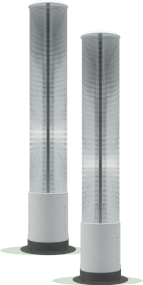
01.
A column of disks extends vertically to a height of ten meters and
become saturated with CO2 from ambient air delivered by wind
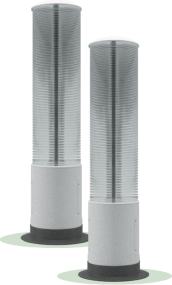
02.
When saturated with CO2 the disks are lowered into a regeneration chamber.
Regeneration Mode
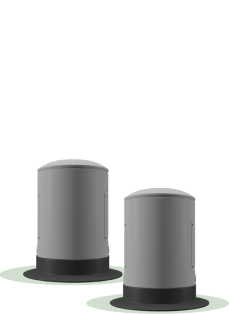
03.
Regeneration occurs to release a greater than 95% purity CO2 product.
The CO2 flows from the regeneration chamber and is processed.
04.
The MechanicalTree™ column extends again to full height to repeat the process